
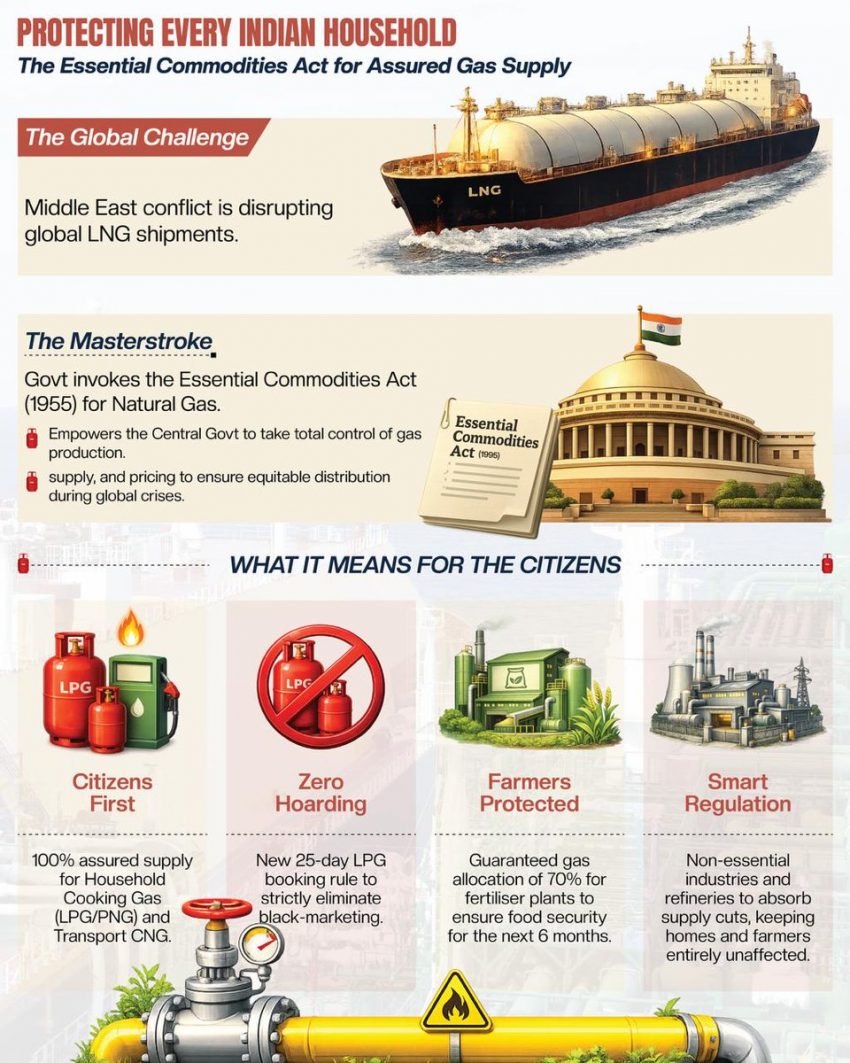
India has taken a historic step by invoking the Essential Commodities Act, 1955 for natural gas supply regulation, signaling a major shift in how the country views energy security. Traditionally used to control food commodities such as wheat, pulses, and edible oil during shortages, the law is now being applied to the energy sector to ensure stable supply of LPG and natural gas. The move reflects growing concerns over global supply disruptions, geopolitical tensions, and rising domestic demand for fuel. By bringing energy under the framework of the Essential Commodities Act, the government has effectively recognized that fuel availability is now as critical to national stability and economic functioning as food security. HSD & MS Prices in India May Rise as Global Crude Oil Surges Amid Geopolitical Conflicts
1. Essential Commodities Act, 1955: From Food Security to Energy Security
The Essential Commodities Act, 1955 was enacted by the Government of India to ensure the availability of critical commodities for the public and prevent hoarding, black marketing, and artificial price inflation. Traditionally, the Act has been invoked to regulate food commodities such as wheat, rice, pulses, sugar, onions, and edible oils during periods of supply disruption or price volatility. However, in a historic policy shift, India has invoked the Act to regulate natural gas supply—marking one of the first instances where a law designed primarily for food security has been applied to the energy sector. This move signals that energy security is now being treated with the same strategic importance as food security, reflecting the evolving nature of national economic and geopolitical risks.
2. Why the Government Invoked the Act for Natural Gas
The decision to invoke the Essential Commodities Act for energy comes amid rising geopolitical tensions in West Asia and concerns about disruptions to global energy supply chains. A significant portion of India’s oil and liquefied natural gas imports travel through the Strait of Hormuz, one of the world’s most critical energy trade routes. Any conflict or logistical disruption in this region can affect fuel availability and prices in India. At the same time, domestic demand for LPG and natural gas continues to grow due to urbanization, transport sector expansion, and industrial consumption. The government feared potential LPG shortages, panic buying, and market speculation. By invoking the Act, authorities aim to maintain supply stability and prevent disruptions that could affect households, industries, and transportation networks.
3. Government Action Under the Natural Gas Supply Regulation Order
Using the powers granted under Section 3 of the Essential Commodities Act, the government introduced the Natural Gas (Supply Regulation) Order, 2026, allowing authorities to regulate production, allocation, and distribution of natural gas. Implementation of the regulation is managed by Gas Authority of India Limited and Petroleum Planning and Analysis Cell. These institutions oversee allocation frameworks and ensure that gas supply reaches priority sectors. The order also empowers authorities to redirect gas supplies if necessary and enforce compliance across refineries, gas producers, and distributors. This regulatory intervention helps maintain stable supply during uncertain global market conditions.
4. Priority Allocation Framework for Natural Gas Distribution
To ensure equitable distribution of energy resources, the government has created a structured priority allocation framework. Domestic PNG (piped natural gas), CNG used for transportation, LPG production, and pipeline operations fall under the highest priority category, receiving full supply based on historical averages. Fertilizer plants receive a substantial allocation to protect agricultural productivity and food supply chains. Manufacturing industries, tea plantations, and other industrial consumers receive moderated allocations to ensure economic activity continues without overwhelming the supply system. Refineries and city gas distribution networks are also included under controlled allocation to maintain operational stability. This framework ensures that critical sectors such as household cooking fuel, transportation, and agriculture remain protected during supply disruptions.
5. Strategic Implications for India’s Energy Policy
India’s decision to treat natural gas as an essential commodity represents a broader shift in national policy thinking. Energy is not only an economic resource but also a strategic asset linked to national security, industrial productivity, and social welfare. By invoking the Essential Commodities Act for energy regulation, the government is acknowledging that fuel supply disruptions can have cascading effects across the economy. The move also highlights India’s continued dependence on imported energy and the vulnerability of global supply chains. Going forward, it may accelerate efforts to expand domestic gas production, diversify energy imports, strengthen strategic reserves, and invest in renewable energy sources. In essence, this policy decision reinforces the idea that energy security is central to India’s long-term economic resilience and national stability.
Knowledge Graph
-
Law: Essential Commodities Act, 1955
-
Government Action: Natural Gas (Supply Regulation) Order, 2026
-
Sector: Energy Security / Natural Gas Supply
-
Key Implementing Bodies: GAIL, Petroleum Planning and Analysis Cell
-
Priority Sectors: Domestic PNG, CNG Transport, LPG Production, Fertilizer Plants, Manufacturing Industries
-
Strategic Context: West Asia geopolitical tensions, Strait of Hormuz supply risks, LPG demand growth in India
-
Policy Objective: Prevent shortages, stabilize prices, ensure equitable distribution of natural gas
Keywords
Essential Commodities Act energy India, natural gas supply regulation India 2026, India energy security policy, Essential Commodities Act 1955 natural gas, LPG shortage India government action, Natural Gas Supply Regulation Order 2026, India fuel supply regulation policy, energy national security India, natural gas allocation priority sectors India, India energy crisis policy response.