
The global fuel retail industry relies on structured partnership frameworks to manage high-value real estate, volatile inventory, and strict quality control. In countries with massive refueling networks like India, oil marketing companies (OMCs) use four distinct business models to expand their footprint: COCO, DOCO, CODO, and DODO. These acronyms represent how land ownership and daily operations are split between the corporate oil company and private dealers.
Understanding these models is essential for landowners looking to lease property, entrepreneurs entering the franchise sector, and consumers seeking guaranteed fuel quality.
1. COCO: Company Owned, Company Operated
In the COCO framework, the oil marketing company retains complete control over the entire asset and its daily management.
- Ownership: The oil company buys or holds a long-term lease on the land and builds all physical infrastructure.
- Operations: Corporate employees or direct company contractors manage the daily fuel dispensing, cash collection, and staffing.
- Key Purpose: These serve as flagship stations. They are usually massive setups on major national highways or premium metropolitan hubs. OMCs use COCO outlets to pilot new technologies, introduce premium fuel variants, and set a benchmark for brand standards.
Pros & Cons
- Advantages: Absolute control over quality and quantity; zero risk of franchisee-level malpractice; perfect execution of corporate branding.
- Disadvantages: Highly capital-intensive; slows down expansion speed due to high land acquisition costs; heavy administrative burden on the corporation.
2. DOCO: Dealer Owned, Company Operated
The DOCO model combines private real estate with corporate operational management.
- Ownership: A private individual (the dealer) owns the land and provides it to the oil company on a long-term lease.
- Operations: The oil company steps in to set up the dispensing units, manage daily inventory, handle pricing, and run the forecourt with its own staff.
- Key Purpose: This allows oil companies to secure premium retail space in high-density areas where buying land outright is too expensive or legally restricted.
Pros & Cons
- Advantages: Landowners get a secure, passive, hands-off income stream without dealing with labor management or fuel evaporation losses. Companies expand quickly with reduced real estate costs.
- Disadvantages: The dealer has no control over daily operations or business growth, while the company bears the ongoing operational expenses of running the site.
3. CODO: Company Owned, Dealer Operated
Under the CODO framework, the oil company controls the real estate but delegates the daily retail operations to an independent franchisee.
- Ownership: The oil corporation owns or leases the land and sets up the entire petrol pump infrastructure.
- Operations: The company rents or licenses the operational rights to a private dealer. This dealer manages the staff, handles daily cash flows, and receives a commission per liter of fuel sold.
- Key Purpose: OMCs use this model to leverage local entrepreneurial talent to run stations efficiently while keeping strict ownership of strategically vital real estate.
Pros & Cons
- Advantages: The dealer enters the lucrative fuel business with minimal capital investment since they do not need to buy land or heavy equipment. The company maintains long-term real estate control.
- Disadvantages: Dealers face tight corporate oversight and strict standard operating procedures, leaving little room for independent business decisions.
4. DODO: Dealer Owned, Dealer Operated
The DODO model is the most traditional and widespread franchise framework in the fuel retailing sector.
- Ownership: The private dealer owns the land, funds the basic infrastructure development, and holds the retail license.
- Operations: The same private dealer manages the daily operations, employs the staff, handles inventory, and drives the station’s profitability.
- Key Purpose: This is the primary driver of rapid rural and semi-urban expansion for oil brands, relying heavily on local networkers and investors.
Pros & Cons
- Advantages: OMCs achieve rapid, asset-light expansion. Dealers enjoy high operational independence and keep a larger share of the profits.
- Disadvantages: High initial investment for the dealer. OMCs face a constant challenge in monitoring these sites to ensure uniform customer service and strict quality compliance.
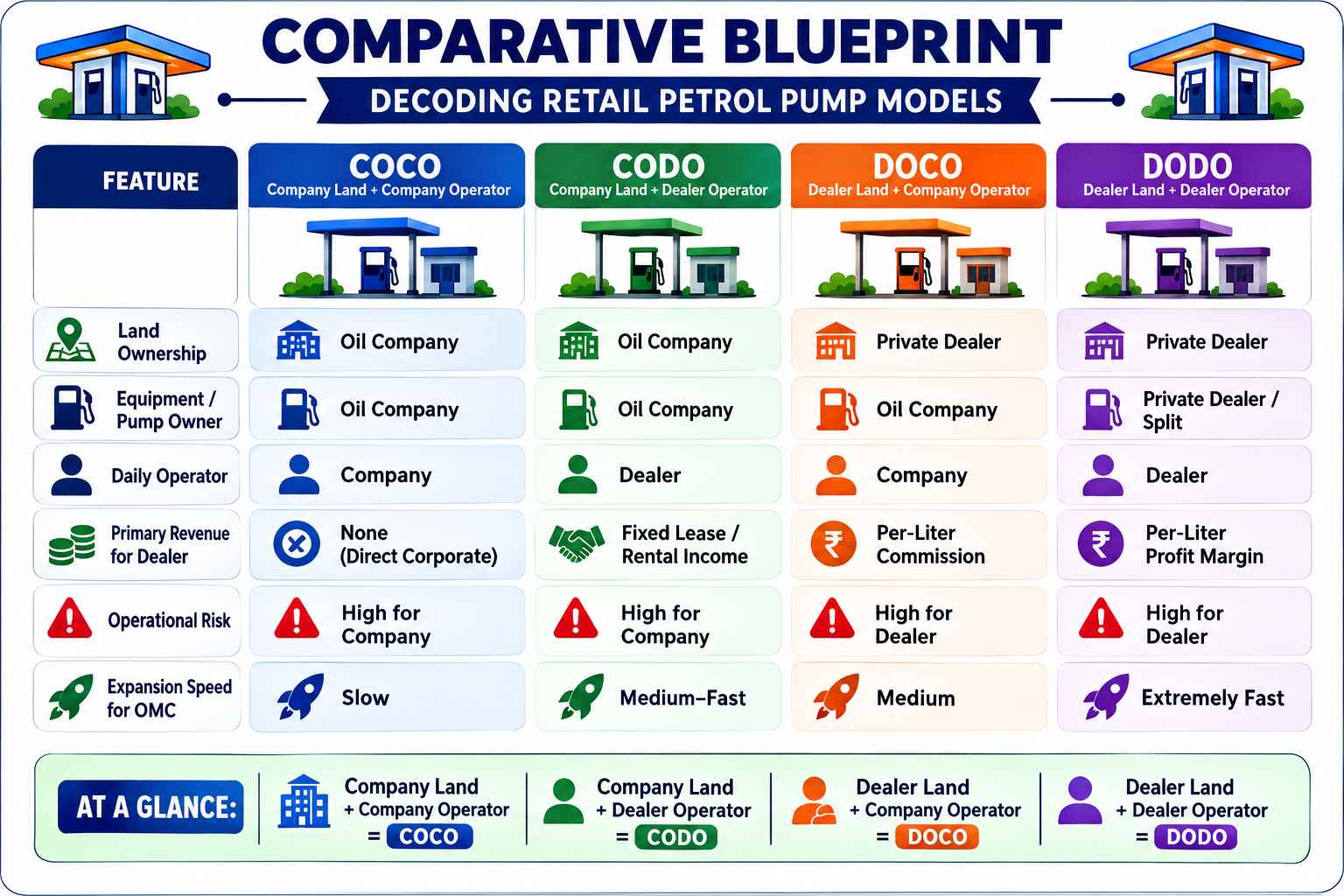
Comparative Blueprint
| Feature | COCO | COCO | DOCO | DODO |
|---|---|---|---|---|
| Land Ownership | Oil Company | Private Dealer | Oil Company | Private Dealer |
| Equipment / Pump Owner | Oil Company | Oil Company | Oil Company | Private Dealer / Split |
| Daily Operator | Oil Company | Oil Company | Private Dealer | Private Dealer |
| Primary Revenue for Dealer | None (Direct Corporate) | Fixed Lease / Rental Income | Per-Liter Commission | Per-Liter Profit Margin |
| Operational Risk | High for Company | High for Company | High for Dealer | High for Dealer |
| Expansion Speed for OMC | Slow | Medium–Fast | Medium | Extremely Fast |
The Evolving Landscape
As the energy sector transitions toward a mix of fossil fuels and green energy, these four models are adapting. Modern fuel stations under all four structures are increasingly being upgraded to feature EV fast-charging grids, CNG bays, and non-fuel retail facilities like convenience stores and quick-service restaurants.
If you are analyzing these options for an investment or application, let me know:
- Are you evaluating a specific model to utilize an existing land parcel?
- Would you like details on the typical selection criteria and security deposits required by Indian OMCs for these setups?