
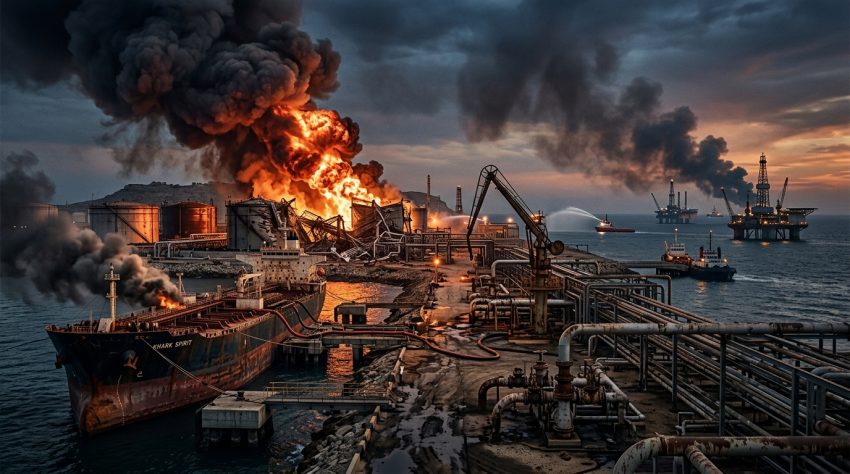
Explosions Near Kharg Island: What We Know So Far
On the evening of 5 September 2026, reports emerged of multiple explosions heard in the vicinity of Kharg Island, Iran’s principal crude oil export terminal located in the northern reaches of the Persian Gulf. The origin of the blasts — whether aerial, naval, or the result of an on-shore incident — remained unconfirmed as of the time of publication, with neither Iranian state media, the Islamic Revolutionary Guard Corps (IRGC), nor any foreign government claiming responsibility or providing a definitive explanation.
Kharg Island handles an estimated 90–95% of Iran’s crude oil exports, making it one of the most strategically sensitive energy installations on the planet. Even unverified reports of a security incident in its vicinity are sufficient to move global oil markets and trigger emergency reviews in energy ministries from Beijing to New Delhi.
Regional shipping-intelligence sources reported that at least two vessels in the area activated their Automatic Identification System (AIS) transponders in distress mode before going silent — a detail that, while unconfirmed, deepened anxieties among commodity traders monitoring the situation overnight.
Why Kharg Island Is the Jugular Vein of Iranian Oil
To understand why any incident near Kharg Island triggers immediate global concern, it is essential to appreciate the terminal’s role in the architecture of Iranian — and therefore global — oil supply. Built on a small island approximately 25 kilometres off the coast of Khuzestan province, the facility was originally developed in the 1950s and 1960s during the era of the Anglo-Iranian Oil Company, the predecessor to what is now BP.
Today, the island hosts a vast network of storage tanks, single-point mooring buoys, and deep-water jetties capable of loading Very Large Crude Carriers (VLCCs) and Ultra Large Crude Carriers (ULCCs). Iran, currently producing in the range of 3.2–3.4 million barrels per day (bpd) according to secondary-source estimates compiled by OPEC in its most recent Monthly Oil Market Report, funnels nearly all of that exportable surplus through Kharg.
The island has been targeted before — most notably during the Iran-Iraq War (1980–1988), when Iraqi air strikes repeatedly damaged facilities and disrupted exports during what became known as the “Tanker War.” The memory of that conflict remains deeply embedded in the strategic calculus of every energy-importing nation, particularly those in Asia.
Immediate Market Reaction and the Risk Premium
Global benchmark crude prices had already been trading with a modest geopolitical risk premium through August 2026, partly driven by unresolved tensions between Iran and a coalition of Gulf Cooperation Council (GCC) states over maritime boundaries, and partly by renewed uncertainty around the implementation of any successor agreement to the 2015 Joint Comprehensive Plan of Action (JCPOA). News of the Kharg Island explosions injected fresh volatility into an already nervous market.
Brent crude futures spiked by approximately $4–5 per barrel in early Asian trading on 5 September 2026, while West Texas Intermediate (WTI) followed suit. Analysts at energy consultancies including Wood Mackenzie and S&P Global Commodity Insights cautioned that sustained disruption to Kharg Island’s export capacity could push Brent toward the $100-per-barrel threshold within days, a level not seen consistently since early 2024.
| Indicator | Pre-Incident Level (4 Sep 2026) | Post-Incident Level (5 Sep 2026, early trade) |
|---|---|---|
| Brent Crude ($/bbl) | ~$88.40 | ~$92.80–93.50 (indicative) |
| WTI Crude ($/bbl) | ~$85.10 | ~$89.40–90.20 (indicative) |
| Iran Crude Export Volume (bpd, est.) | ~1.6–1.8 million | Status uncertain pending verification |
| Strait of Hormuz Transit (bpd, avg.) | ~18–19 million | No confirmed disruption as of filing |
India’s Energy Security Exposure: A Critical Assessment
For India, the implications of any sustained disruption to Persian Gulf oil flows are immediate and structural. India is the world’s third-largest crude oil importer, sourcing roughly 85–88% of its crude requirements from overseas. The Middle East — particularly Iraq, Saudi Arabia, the UAE, and, to a degree that has grown significantly since Western sanctions created price arbitrage opportunities, Iran — accounts for the bulk of those imports.
State-owned refiners including Indian Oil Corporation Limited (IOCL), Bharat Petroleum Corporation Limited (BPCL), and Hindustan Petroleum Corporation Limited (HPCL) collectively process over 5 million bpd of crude. Supply disruptions that elevate global benchmark prices directly translate into higher input costs, squeezing refining margins and, eventually, putting upward pressure on retail fuel prices for Indian consumers — currently regulated through a combination of market-linked pricing and periodic government intervention.
ONGC Videsh, the overseas investment arm of state explorer Oil and Natural Gas Corporation (ONGC), also holds upstream equity stakes in fields across the Middle East and Central Asia. A deterioration of the security environment in the Persian Gulf could complicate operations and asset valuations across that portfolio.
The Ministry of Petroleum and Natural Gas in New Delhi is understood to monitor Persian Gulf security incidents in real time through a dedicated energy security cell, and senior officials are likely to have been briefed overnight. India’s Strategic Petroleum Reserves (SPR) — maintained at facilities in Visakhapatnam, Mangalore, and Padur — currently hold enough crude to cover approximately 9–10 days of consumption, a buffer that energy policy experts have long argued needs expansion.
The Broader Geopolitical Context: Escalation Risks in 2026
The Kharg Island incident does not occur in a vacuum. The Persian Gulf has been experiencing a steady ratcheting of tensions through 2026, driven by several overlapping dynamics: unresolved negotiations over Iran’s nuclear programme, recurring incidents involving the harassment of commercial shipping attributed to the IRGC Navy, and the broader proxy conflict architecture that continues to draw in regional and extra-regional powers.
The United States Fifth Fleet, headquartered in Bahrain, has maintained an elevated operational posture in the region since early 2026, and the Combined Maritime Forces (CMF) coalition has increased escort operations for commercial tankers transiting the Strait of Hormuz — through which roughly 20% of the world’s traded oil passes daily. Saudi Arabia’s Aramco has quietly reviewed its own contingency protocols for accelerated exports through the East-West Pipeline to the Red Sea terminal at Yanbu, a route that bypasses the Strait entirely.
Meanwhile, China, Iran’s largest single crude buyer, has been closely watching developments. Beijing’s refining giants — Sinopec and PetroChina — have significant exposure to Iranian barrels through opaque trading channels, and any disruption to Kharg Island exports would force Chinese buyers to compete more aggressively for alternative Middle Eastern and Russian grades, further tightening the market for Asian importers like India.
Conclusion
The explosions reported near Kharg Island on 5 September 2026 serve as a stark reminder of how geographically concentrated and therefore vulnerable the world’s oil supply architecture remains. While the origin and full impact of the incident are yet to be confirmed, the mere possibility of damage to Iran’s premier export terminal is enough to inject significant risk premium into global crude markets. For India — heavily dependent on Middle Eastern oil, running lean strategic reserves, and managing a fuel-price-sensitive electorate — the situation demands close monitoring and, in the medium term, an accelerated push toward supply diversification and SPR expansion. The energy world will be watching Kharg Island carefully in the hours and days ahead.
By FuelWings Energy Desk · Reviewed by FuelWings Editorial Team · Published 05 September 2026 IST. FuelWings covers India & global oil, gas and fuel-price news; figures are verified against the original report and public data.
Topics: Kharg Island, Iran oil exports, Persian Gulf security, crude oil prices, India energy security, OPEC, Strait of Hormuz, IOCL.
Source: ET EnergyWorld (Oil & Gas) ↗