
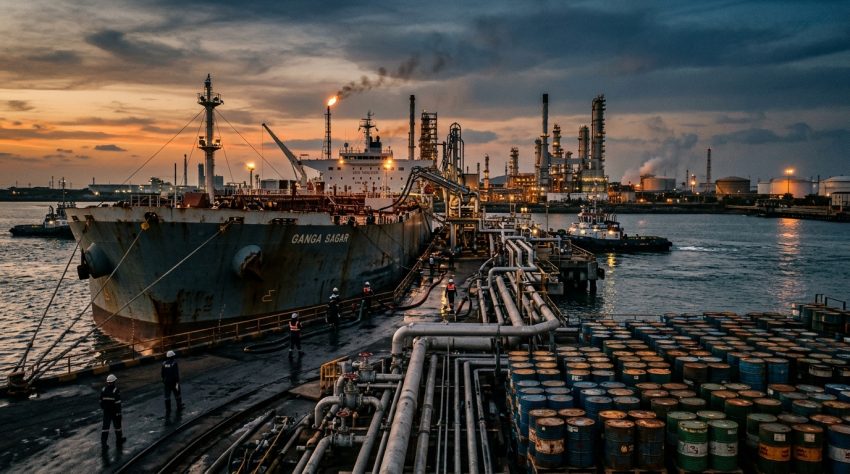
How Freight Rate Surges Are Reshaping India’s Refinery Economics
The Indian refining sector is confronting a structural headwind that extends far beyond crude oil pricing itself. Elevated international freight rates are progressively narrowing the geographic and sourcing flexibility that India’s refinery operators have traditionally leveraged to optimize feedstock costs. This constraint arrives at a particularly challenging moment, when refinery margins—already compressed by seasonal demand patterns and global supply dynamics—are providing limited cushion against additional transportation expense burdens.
For Indian Energy majors like Indian Oil Corporation Limited (IOCL), Reliance Industries, and Mangalore Refinery and Petrochemicals Limited (MRPL), the calculus of crude procurement has shifted measurably. What was once a straightforward arbitrage opportunity—sourcing cheaper, distant crude grades and absorbing moderate shipping premiums—is becoming economically marginal or unviable at current freight trajectories.
The Freight Rate Squeeze: Direct Impact on Refinery Feedstock Costs
Global maritime freight rates for crude oil tankers have remained elevated throughout 2026, driven by persistent vessel demand imbalances, continued Red Sea shipping disruptions affecting Asia-Europe routes, and the absence of substantial capacity additions to counter demand spikes. For a typical Very Large Crude Carrier (VLCC) route from the Middle East to India, freight premiums have stabilized in the USD 2.50–3.50 per barrel range—substantially above the sub-USD 1.50 level seen during pandemic-era oversupply conditions.
This transportation premium, while abstract in refinery boardrooms, translates directly into tangible margin compression at the production gate. Consider a representative scenario: when Indian Oil or MRPL evaluate sourcing a cargo of West African crude (typically 200,000-barrel parcels), the freight component now represents 5-7% of the delivered cost at Paradip, Vadinar, or Vizag refineries. In an operational environment where refinery margins average USD 3–5 per barrel, a 50-cent freight headwind eliminates 10-15% of processing profitability on that particular feedstock decision.
Why Refinery Margin Pressure Makes Freight Costs Critical
The timing of this freight-rate elevation compounds existing margin pressures unique to India’s refining landscape in late 2026. Seasonal demand softness in October-November typically reduces fuel crack spreads (the differential between refined product value and crude input cost), as heating-oil demand in the Northern Hemisphere remains subdued and Indian domestic petrochemical demand stays cyclically weak.
Additionally, the Indian government’s policy stance on retail fuel pricing—where pump prices for petrol and diesel remain politically sensitive and do not fully pass through crude cost movements—creates a structural cap on downstream profitability. This means refinery operators cannot simply raise output prices to offset freight-driven input cost inflation. Instead, they absorb margin compression or reduce throughput.
Refiners consequently face a binary choice: accept lower margins on long-haul crude sources, or pivot toward higher-cost, proximate crudes (such as Middle Eastern Oman or Arab Light grades) where freight premiums are lower but baseline crude costs may be 50 cents to USD 1.50 per barrel higher. Neither option optimizes net profitability.
Shifts in Crude Sourcing: Strategic Implications for India’s Refiners
The structural response from India’s refining cohort is becoming observable in crude procurement patterns during Q4 2026. IOCL, which processes approximately 1.45 million barrels per day across its Paradip, Mathura, and Haldia facilities, has visibly increased its allocation toward Middle Eastern crude (Saudi Aramco’s Arab Light and Arab Medium grades), which command shorter voyage distances and thus lower freight expenses. Reliance Industries, operating the world’s largest refinery complex at Jamnagar with approximately 1.4 million barrels-per-day capacity, has similarly reduced its participation in competitive bidding for premium West African sweet crudes, where freight premiums erode the nominal crude-quality premium.
This rebalancing carries cascading implications. West African producers (Angola, Nigeria, Ghana) face reduced offtake demand from Indian refineries, potentially moderating their crude export prices or driving volumes toward other Asian buyers or strategic petroleum reserve programs. Simultaneously, Middle Eastern producers gain enhanced pricing power in the Asian market, as Indian refiners’ reduced geographic optionality strengthens demand for their proximate, freight-efficient barrels.
Over a multi-year horizon, this dynamic risks calcifying Indian refineries into a more rigid, geography-dependent procurement posture—precisely the opposite of the diversification strategy that IOCL, MRPL, and others pursued following the 2014 oil-price collapse and subsequent supply-chain volatility.
Market Indicators & Pressure Points Through Q4 2026
Observable data points underscore the tightening procurement environment. The Platts Worldscale (WS) for VLCC freight from the Arabian Gulf to Southeast Asia (a proxy for India-relevant routes) has oscillated in the WS 60–75 range since August 2026, compared to the WS 45–55 range during the relatively benign freight environment of 2023–early 2024. Simultaneously, refinery utilization rates at major Indian facilities have dipped toward 85-88% in some weeks of October, suggesting that refiners are consciously moderating throughput rather than absorbing uneconomical feedstock costs.
The Reserve Bank of India’s latest energy-sector assessment (released mid-October 2026) specifically flagged elevated shipping costs as a persistent near-term risk to refinery sector profitability and downstream energy affordability for Indian consumers. This acknowledgment signals that policy-makers view the freight-rate issue as material enough to warrant monitoring alongside traditional crude-price and currency variables.
Implications for India’s Energy Cost Inflation & Policy Response
If freight rates sustain elevated levels into 2027, Indian refineries face a forced choice: accept margin compression, seek regulatory relief or subsidy mechanisms (unlikely given fiscal constraints), or further moderate throughput and thereby reduce fuel supply to India’s growing transport and petrochemical sectors. None of these outcomes is benign for India’s inflation trajectory or industrial competitiveness.
The petroleum ministry and the regulator (Petroleum Planning & Analysis Cell) are likely to face pressure from refinery operators for cost-recovery mechanisms or tariff protection. Historically, India’s refining sector has been relatively insulated from direct subsidy, but prolonged margin compression could alter that political calculus, particularly if fuel-supply tightness pushes retail prices upward ahead of elections or sensitive consumption cycles.
Conclusion: A Narrowing Window for Refinery Flexibility
The convergence of elevated freight rates and constrained refinery margins represents a structural headwind that Indian refiners cannot sidestep through operational efficiency alone. The industry’s traditional advantage—geographic flexibility in crude sourcing—is being eroded by shipping economics that have shifted decisively against long-haul, premium-quality feedstock procurement. In the near term, this will likely manifest as reduced offtake from West African suppliers, increased dependence on Middle Eastern barrels, and further margin compression at Indian refineries through late 2026 and into 2027. Policymakers and investors should monitor refinery throughput and fuel-supply dynamics closely; if this trend persists, India’s energy-cost inflation and downstream sector competitiveness could face renewed pressure.
By FuelWings Energy Desk · Reviewed by FuelWings Editorial Team · Published 29 October 2026 IST. FuelWings covers India & global oil, gas and fuel-price news; figures are verified against the original report and public data.
Topics: shipping costs oil refining, Indian crude procurement strategy, refinery margins pressure, global freight rates 2026, IOCL Reliance crude sourcing, energy cost inflation India.
Source: ET EnergyWorld (Oil & Gas) ↗