
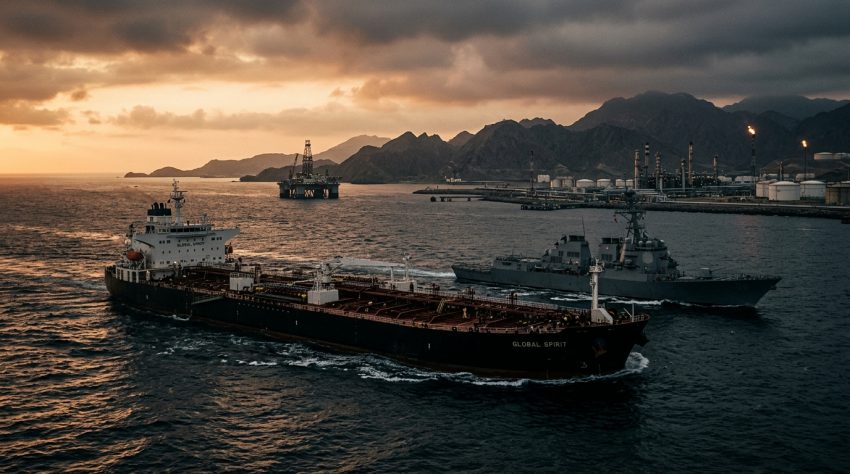
Iran Escalates Rhetoric on US Naval Presence in Persian Gulf
As October 2026 unfolds, Iran has intensified its public stance against what it characterises as destabilising US military activities in the Persian Gulf, issuing fresh warnings to prevent American naval vessels from operating in the strategically critical waterway. This rhetorical escalation, coupled with underlying geopolitical friction between Washington and Tehran, has created measurable uncertainty in global crude markets and poses direct consequences for India’s energy import strategy.
Tehran’s statement represents the latest chapter in a prolonged tug-of-war over Gulf maritime supremacy. While Iranian officials have periodically issued similar declarations over the past decade, the current messaging carries additional weight given the concurrent fragility of regional stability mechanisms and the absence of meaningful diplomatic de-escalation channels. Unlike previous instances where such rhetoric remained largely symbolic, current conditions—including heightened US carrier deployments and Iranian military exercises—suggest a narrower margin for miscalculation.
Strategic Importance of the Persian Gulf for Global Energy Markets
The Persian Gulf remains the world’s most critical energy chokepoint. Approximately 21 million barrels of crude oil and condensates transit the Strait of Hormuz daily—roughly one-quarter of all seaborne traded petroleum. For India specifically, the Gulf region accounts for nearly 60% of crude oil imports, with major suppliers including Iraq, Saudi Arabia, Iran (historically), Kuwait, and the United Arab Emirates.
Any disruption to maritime freedom of navigation in this zone has immediate ripple effects across global energy pricing. The Brent crude benchmark, which remains the pricing reference for Indian refineries purchasing Arabian crude, would face upward pressure even from perceived supply-chain risk. Current geopolitical premiums embedded in crude prices already reflect baseline concerns about Iranian actions; heightened tensions typically add $3–$8 per barrel to forward prices within days of significant incidents.
India’s downstream sector—particularly integrated refiners like Indian Oil Corporation (IOCL), Hindustan Petroleum Corporation (HPCL), and Bharat Petroleum Corporation (BPCL)—operate on tight margin profiles. These three entities collectively process approximately 1.7 million barrels per day domestically. A sustained crude price spike driven by Persian Gulf turmoil directly compresses their refining margins and, by extension, affects fuel retail pricing for Indian consumers.
India’s Exposure to Persian Gulf Energy Disruptions
India’s vulnerability to Persian Gulf volatility operates on multiple dimensions. First, on the import side, India holds strategic petroleum reserves (SPR) totalling approximately 5.33 million barrels as of mid-2026—sufficient for only 9–10 days of national consumption at current demand levels. This modest buffer leaves limited room for extended supply interruptions. Second, India lacks alternative crude sourcing flexibility; while Russian supplies have increased post-2022, African and Atlantic Basin crudes command premium pricing. Third, Indian refineries have invested heavily in processing light sweet crudes predominantly sourced from the Gulf, constraining their ability to rapidly switch feedstock quality without operational challenges.
Should Iran-US tensions materialise into actual naval incidents—such as blockade attempts, ship seizures, or strikes on shipping infrastructure—India’s energy security posture would face acute stress. The cost of crude would spike, SPR drawdowns would be politically controversial, and fuel prices would rise at the pump. Consumer inflation and industrial competitiveness would suffer. Conversely, if tensions remain rhetorical without kinetic escalation, markets may eventually price in a ‘risk premium’ that stabilises within a manageable band.
Regional Military Posturing and De-escalation Risks
The current Iranian warning arrives amid broader patterns of military posturing. The US Navy maintains a continuous carrier strike group presence in the Arabian Sea and regularly transits the Strait of Hormuz in freedom-of-navigation operations. Iran’s Islamic Revolutionary Guard Corps (IRGC) Navy and broader armed forces conduct counter-exercises, test naval systems, and issue public statements framing Gulf security as an existential sovereignty matter.
Historically, these cycles have resolved without major incidents—proximity crises, occasional ship encounters, and economic sanctions remain the primary tools rather than kinetic warfare. However, the absence of formal conflict-resolution mechanisms or back-channel diplomatic engagement between Washington and Tehran increases the risk that a low-level incident could trigger unintended escalation. Miscalculation, technical malfunction, or a change in political leadership in either nation could alter calculus rapidly.
For India and other energy-importing nations, this environment demands contingency planning. Energy security frameworks must account for both base-case (managed tension, no major incidents) and stress-case (supply disruption, price spikes) scenarios.
Implications for Indian Oil and Gas Policy
India’s Ministry of Petroleum & Natural Gas faces mounting pressure to diversify energy sourcing. Current policy priorities—including expanded renewable capacity, domestic gas production from deepwater fields, and liquefied natural gas (LNG) contracts—are partly driven by Persian Gulf concentration risk. However, the 2026 timeframe shows these alternatives remain supplementary rather than substitutional. Renewable electricity penetration is rising but does not displace transport fuel demand (petrol, diesel) that depends on crude refining. LNG import capacity has grown, but natural gas still represents only ~6% of India’s primary energy mix.
India’s dialogue with OPEC member states—particularly Saudi Arabia and UAE—remains diplomatically critical. Both nations have capacity to increase crude exports if required, yet both also balance relationships with the US and Iran, limiting their ability to unilaterally guarantee supply surges during a crisis. India’s engagement with Russian crude suppliers also reflects this hedging approach, though sanctions complications and shipping insurance challenges limit scaling.
From a policy standpoint, India should consider: (1) accelerating SPR expansion to 2–3 weeks of consumption coverage, (2) deepening bilateral energy partnerships with non-Gulf suppliers, (3) investing in refinery flexibility to process diverse crude grades, and (4) maintaining diplomatic channels with regional actors to gather early-warning signals of escalation.
Market Sentiment and Price Volatility Outlook
As of late October 2026, crude markets are pricing Iranian rhetoric with measured concern. Brent crude has fluctuated in the $75–$82 per barrel range over the preceding weeks, with geopolitical premium estimated at $2–$4 per barrel relative to fundamentals-only models. Should new incidents occur—such as US strikes on Iranian installations, IRGC harassment of commercial shipping, or blockade declarations—crude could test $90–$95 levels within days. Conversely, if tensions plateau or diplomatic statements emerge, prices may stabilise or drift lower as other supply-demand factors dominate.
For Indian fuel consumers and industry, this translates to uncertainty in petrol and diesel pricing. Retail fuel pricing in India remains semi-deregulated; while private retailers have full flexibility, government-owned outlets still face occasional margin compression during price shocks. This political economy creates periodic inconsistency in consumer-facing pricing, adding a layer of complexity to household budgeting and logistics-company cost planning.
Conclusion
Iran’s renewed warning against US military operations in the Persian Gulf underscores a persistent geopolitical fault line that directly threatens India’s energy security architecture. With crude imports accounting for ~$80–$100 billion annually in India’s external spending and representing a significant portion of headline inflation, any supply disruption or price shock carries economy-wide implications. While current tensions remain below kinetic escalation thresholds, the structural absence of conflict-resolution mechanisms and the historical volatility of Iran-US relations justify vigilant monitoring and contingency planning. India’s energy policymakers must balance short-term price management with medium-term diversification strategies, recognising that Persian Gulf volatility is an enduring feature of the global energy system rather than a temporary aberration.
By FuelWings Energy Desk · Reviewed by FuelWings Editorial Team · Published 25 October 2026 IST. FuelWings covers India & global oil, gas and fuel-price news; figures are verified against the original report and public data.
Topics: Persian Gulf crude oil security, Iran US military escalation, India oil imports geopolitical risk, global energy price volatility, Strait of Hormuz shipping, OPEC geopolitical tensions.
Source: ET EnergyWorld (Oil & Gas) ↗