
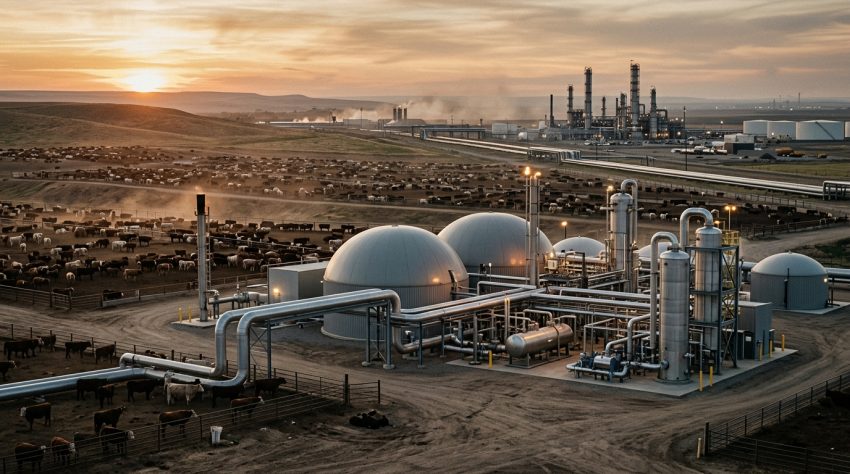
In what could be a pivotal moment for agricultural waste-to-energy innovation, a cattle feedlot in Broken Bow, Nebraska has officially broken ground on a large-scale renewable natural gas (RNG) facility that will convert animal manure into pipeline-quality fuel. The project, operated by Neogenyx Fuels at the Adams Land & Cattle feedlot, is designed to deploy eight anaerobic digesters capable of producing approximately 1.2 million MMBtu of natural gas per year — enough to power tens of thousands of American homes or serve as a low-carbon bunker fuel for international shipping.
Nebraska Feedlot Breaks Ground on Landmark Biogas Project
“The Adams Land & Cattle RNG facility demonstrates how American agriculture can play an important role in the future of renewable fuels,” said Michael Bakas, CEO of Neogenyx Fuels, who also underscored the project’s potential to feed bio-LNG into global maritime markets. For a sector under intense pressure to decarbonise — international shipping alone accounts for roughly 2.5% of global greenhouse gas emissions — a reliable, traceable, low-carbon fuel supply chain rooted in agricultural byproducts is both commercially and strategically significant.
As of 5 September 2026, the global energy transition is no longer a distant policy aspiration but an active competitive arena. Projects like the Nebraska RNG facility illustrate how the United States is increasingly integrating its agricultural sector into its broader clean energy infrastructure — a strategy India is watching closely, given its own vast livestock base and growing gas infrastructure ambitions.
How Anaerobic Digestion Turns Waste Into Watts
The science underpinning this project is well-established, though large-scale deployment at feedlot operations of this magnitude remains relatively rare. Anaerobic digestion involves microorganisms breaking down organic matter — in this case, cattle manure — in the absence of oxygen. The process produces biogas, a mixture predominantly composed of methane (CH₄) and carbon dioxide (CO₂). This raw biogas is then purified and upgraded to pipeline-quality RNG, which is chemically indistinguishable from conventional fossil natural gas.
The eight digesters at the Broken Bow facility will handle the waste output of one of the American Midwest’s large-scale beef cattle operations. At full capacity, the facility is projected to eliminate approximately 63,700 metric tonnes of greenhouse gas emissions annually — a reduction equivalent to taking over 13,000 petrol-fuelled cars off the road each year.
Critically, the carbon intensity of biogas projects of this nature is rated by greenhouse gas watchdog organisations at approximately -250 on the carbon intensity scale, a deeply negative score that reflects the fact that capturing methane from decomposing manure actually removes a super-pollutant from the atmosphere before it can be released. Methane is approximately 80 times more potent than CO₂ over a 20-year period, making its capture from agricultural sources one of the highest-leverage climate interventions available today.
Economic Case: Beyond Just Electricity — Targeting Bio-LNG for Shipping
What distinguishes the Neogenyx Fuels approach from earlier biogas projects is its ambition to produce bio-LNG for the global maritime sector, rather than simply injecting RNG into a local utility grid. This positions the Nebraska facility as a potential export-linked energy asset, tapping into tightening International Maritime Organization (IMO) regulations that are forcing shipping companies worldwide to seek verifiably low-carbon fuel alternatives.
The U.S. Environmental Protection Agency (EPA) has long championed biogas recovery as a multi-dimensional rural economic strategy. Beyond direct energy revenues, the agency highlights secondary benefits including soil amendments from digester effluent (digestate), reduced odour and water contamination near livestock facilities, and new income diversification pathways for farmers increasingly squeezed by commodity price volatility.
| Parameter | Adams Land & Cattle RNG Project |
|---|---|
| Location | Broken Bow, Nebraska, USA |
| Operator | Neogenyx Fuels |
| Technology | Anaerobic digestion (8 digesters) |
| Annual RNG Output | ~1.2 million MMBtu |
| Annual GHG Reduction | ~63,700 metric tonnes CO₂ equivalent |
| Carbon Intensity Score | Approximately -250 |
| Target Market | Pipeline gas + potential bio-LNG for maritime sector |
Critics Raise Hard Questions About Feedlot Scale and Community Impact
Not everyone is convinced that bolting digesters onto industrial-scale animal agriculture solves more problems than it creates. In 2024, fifteen members of the U.S. Congress wrote a pointed letter objecting to USDA funding for large-scale animal agriculture digesters, arguing that such support effectively subsidises an inherently polluting system. Their core contention: that storing hundreds of thousands of gallons of liquid manure — even when digesters are present — continues to degrade air and water quality for surrounding rural communities, many of which are already disproportionately low-income.
This tension sits at the heart of the broader biogas debate. Sam Wade, Director of Public Policy for the Coalition for Renewable Natural Gas, has acknowledged the nuance directly, noting that while digesters measurably reduce odours and some local air pollutants, they are not a complete environmental solution for industrial livestock operations. The underlying land use, water consumption, and broader ecological footprint of large cattle feedlots remains unchanged by a digester installation.
These are legitimate governance questions that policymakers in both the United States and India must wrestle with as biogas infrastructure scales up. The technology is not a silver bullet — but under the right regulatory framework, it meaningfully improves the environmental ledger of operations that will continue to exist regardless.
Implications for India: A Livestock Superpower Sitting on Untapped Biogas Potential
India’s relevance to this story is more than academic. India holds the world’s largest bovine population — estimated at over 300 million cattle and buffalo — generating an enormous volume of organic waste that is currently underutilised from an energy perspective. The government’s GOBAR-Dhan (Galvanizing Organic Bio-Agro Resources Dhan) scheme has been pushing biogas adoption in rural areas, and the City Gas Distribution (CGD) network expansion driven by entities like GAIL (India) Ltd and Indraprastha Gas Ltd is gradually creating pipeline infrastructure that could carry domestically produced RNG.
India’s target of raising natural gas’s share of its primary energy mix from around 6% today to 15% by 2030 — a goal reiterated in successive Union Budgets — hinges not just on LNG imports but increasingly on domestic biogas and compressed biogas (CBG) production. The Sustainable Alternative Towards Affordable Transportation (SATAT) initiative, which aims to establish 5,000 CBG plants across India by 2025, draws from the same playbook as the Nebraska project, albeit at a smaller per-unit scale.
What the Adams Land & Cattle project demonstrates is the viability of aggregating waste streams from large livestock operations into commercially meaningful energy volumes. India’s dairy cooperative hubs — particularly in Gujarat, Punjab, and Uttar Pradesh — and its growing poultry and piggery sectors offer analogous aggregation opportunities. The key gap remains financing structures and offtake certainty, areas where the U.S. model of EPA incentives, Renewable Identification Number (RIN) credits, and long-term gas purchase agreements provides a useful template for Indian policymakers to adapt.
Conclusion
The Neogenyx Fuels project at Adams Land & Cattle in Broken Bow, Nebraska represents a mature, commercially oriented iteration of agricultural biogas technology — one that goes beyond local grid supply to target global shipping fuel markets. Producing 1.2 million MMBtu of renewable natural gas annually while eliminating 63,700 metric tonnes of greenhouse gas emissions, it makes a compelling economic and environmental case for integrating large feedlot operations into the clean energy supply chain. The debate around industrial-scale livestock’s broader environmental footprint is valid and must not be sidestepped by the allure of RNG revenues. But for India — a nation with an unmatched livestock base, an ambitious gas infrastructure buildout, and a growing appetite for low-carbon credentials in its export-linked industries — the Nebraska model offers actionable lessons. Scaling biogas from cattle waste is not just a rural income story; it is an energy security and decarbonisation imperative that deserves far more policy urgency than it currently receives.
By FuelWings Energy Desk · Reviewed by FuelWings Editorial Team · Published 05 September 2026 IST. FuelWings covers India & global oil, gas and fuel-price news; figures are verified against the original report and public data.
Topics: renewable natural gas, biogas from cattle manure, anaerobic digestion, RNG production, bio-LNG, Neogenyx Fuels, Adams Land and Cattle, biogas India.
Source: OilPrice.com ↗