
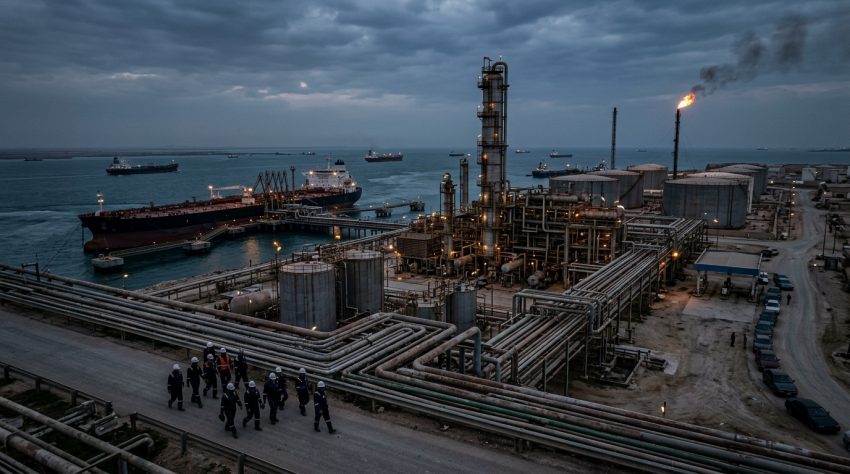
Iraq, one of OPEC’s most prolific crude oil producers and a country sitting atop the world’s fourth-largest proven reserves, is confronting a paradox that has bewildered energy analysts for years: a worsening domestic petrol shortage even as it exports millions of barrels of crude every day. As of early September 2026, that contradiction has sharpened into a genuine supply emergency, compounded by escalating tensions around the Strait of Hormuz — the narrow Persian Gulf chokepoint through which nearly 20 percent of the world’s traded oil and a significant share of refined fuel products pass each day.
Iraq’s Domestic Fuel Shortage Reaches Critical Point
Long queues at filling stations in Baghdad, Basra, and Mosul have become a routine sight in recent weeks. The Iraqi government has struggled to bridge a structural gap between its crude output — which the State Organisation for Marketing of Oil (SOMO) pegs at approximately 4.2 million barrels per day — and its domestic refining capacity, which remains chronically insufficient to meet local demand for motor fuel, diesel, and kerosene. Iraq imports a substantial volume of refined petroleum products, primarily through Gulf maritime routes, and any friction in those corridors hits the domestic supply chain almost immediately.
How Hormuz Tensions Are Choking Refined Product Flows
The Strait of Hormuz, flanked by Iran to the north and Oman and the UAE to the south, has re-emerged as a geopolitical flashpoint in mid-2026. Periodic drone incidents, naval posturing by the Islamic Revolutionary Guard Corps (IRGC), and broader Iran-US tensions over a stalled nuclear framework have collectively pushed up insurance premiums for vessels transiting the strait. Lloyd’s of London war-risk underwriters have reportedly added surcharges of between 0.5 and 1.2 percent of cargo value for Gulf voyages — a cost that traders are factoring into product pricing and, in some cases, using as justification to divert or delay shipments.
For Iraq, this is doubly damaging. Its southern crude export terminal at Al-Faw (Khor al-Amaya and Basra Oil Terminal) lies well within the zone of elevated risk perception, affecting not only outgoing crude tankers but also the incoming vessels carrying refined fuels that Iraqi refineries cannot produce in sufficient volume. Iraq’s primary domestic refineries — including the Baiji Refinery (still only partially operational after Islamic State damage), the Daura Refinery in Baghdad, and the Basra Refinery — have a combined operational capacity well below the country’s consumption needs, creating a structural import dependency that cannot be quickly resolved.
The Refining Gap: A Structural Vulnerability Years in the Making
Iraq’s inability to refine enough fuel for its own population is not a new problem — it is a consequence of decades of war, sanctions, underinvestment, and governance failures. Despite repeated pledges by successive governments in Baghdad to expand domestic refining, progress has been slow. The long-delayed Karbala Refinery, designed with a capacity of 140,000 barrels per day and built with partial Chinese financing, has been one of the most-discussed potential remedies — but commissioning delays have pushed its meaningful contribution to domestic supply further into the future.
Meanwhile, Iraq’s fuel subsidy system, which keeps pump prices artificially low, simultaneously inflates domestic consumption and discourages private investment in the downstream sector. The Iraqi Ministry of Oil has acknowledged the structural nature of the problem but has been reluctant to implement politically sensitive subsidy reforms ahead of any election cycle.
| Indicator | Current Estimate (Sept 2026) | Context |
|---|---|---|
| Iraq Crude Production | ~4.2 mb/d | OPEC second-largest producer |
| Domestic Refining Capacity (operational) | ~600,000 b/d (est.) | |
| Includes Daura, Basra, partial Baiji | Estimated Domestic Fuel Demand | ~850,000–900,000 b/d equivalent | Driven by subsidised prices | Hormuz War-Risk Insurance Surcharge | 0.5–1.2% of cargo value | Lloyd’s of London estimates, mid-2026 | Strait of Hormuz Daily Oil Transit | ~18–20 mb/d | ~20% of global traded oil |
OPEC’s Balancing Act and the Wider Gulf Supply Picture
The situation puts OPEC+ in an awkward position. The group has been carefully managing a phased unwinding of its 2.2-million-barrel-per-day voluntary production cut agreement, with Saudi Arabia, the UAE, and Iraq among those with commitments to gradually restore output through 2026. Any perception that the Hormuz route is compromised tends to lift Brent crude benchmarks even as it paradoxically threatens to suppress actual Gulf export volumes — a price-bullish but supply-bearish combination that complicates OPEC’s messaging.
Saudi Arabia and the UAE, both of which have invested heavily in pipeline infrastructure precisely to bypass Hormuz dependence — including the East-West Pipeline (Petroline) to Yanbu and the ADNOC Habshan-Fujairah pipeline — are better insulated. Iraq has no comparable bypass infrastructure, making it the most exposed major OPEC producer to any genuine disruption of the strait.
Implications for India’s Energy Security and Crude Import Strategy
India has significant skin in this game. Iraq has consistently ranked as India’s single largest crude oil supplier for several years running, accounting for roughly 20–22 percent of total Indian crude imports. State-owned refiners including Indian Oil Corporation Limited (IOCL), Bharat Petroleum Corporation Limited (BPCL), and Hindustan Petroleum Corporation Limited (HPCL) are all significant buyers of Iraqi Basra Heavy and Basra Medium grades.
A sustained disruption to Hormuz transit — even a partial one that raises costs and delays rather than fully blocks flows — would push up the landed cost of Iraqi crude for Indian refiners and could force a rapid diversification toward alternative suppliers: Russia (already India’s largest single source in volume terms through the Urals discount trade), the US (WTI-based grades via longer voyages), or West African producers such as Nigeria and Angola. The Petroleum Planning and Analysis Cell (PPAC) under India’s Ministry of Petroleum & Natural Gas monitors import diversification on a rolling basis and has previously activated contingency sourcing protocols during Gulf crises.
For Indian consumers, a sustained Gulf disruption would likely be transmitted through higher crude import costs, which — given India’s partially administered fuel pricing framework managed by oil marketing companies (OMCs) — could translate into pressure on petrol and diesel retail prices, though the government has shown a willingness to absorb some of that burden through OMC under-recoveries in politically sensitive periods.
ONGC Videsh Limited (OVL), which holds upstream equity stakes in Iraqi fields through past bid rounds, also faces operational uncertainty if ground-level fuel shortages in Iraq disrupt oilfield logistics and workforce mobility within the country.
Conclusion
Iraq’s fuel crisis in September 2026 is a textbook illustration of the resource curse in action: abundant upstream wealth coexisting with downstream poverty. The Hormuz disruption has not created this problem — it has merely exposed and accelerated a structural vulnerability that Baghdad has deferred addressing for decades. For global energy markets, the risk is that Iraq, already an OPEC member under pressure to comply with output agreements, finds its export reliability questioned just as the group needs cohesion. For India, the episode is a timely reminder that import diversification and strategic petroleum reserve adequacy are not optional luxuries but operational necessities in an era of recurring Gulf instability. New Delhi’s energy planners would do well to treat this as a live stress test of India’s crude supply chain resilience, not a distant regional story.
By FuelWings Energy Desk · Reviewed by FuelWings Editorial Team · Published 05 September 2026 IST. FuelWings covers India & global oil, gas and fuel-price news; figures are verified against the original report and public data.
Topics: Iraq petrol shortage, Strait of Hormuz oil supply, OPEC crude disruption, Iraq oil exports 2026, India energy security, Persian Gulf oil route, IOCL crude imports, Iraq fuel imports.
Source: ET EnergyWorld (Oil & Gas) ↗