
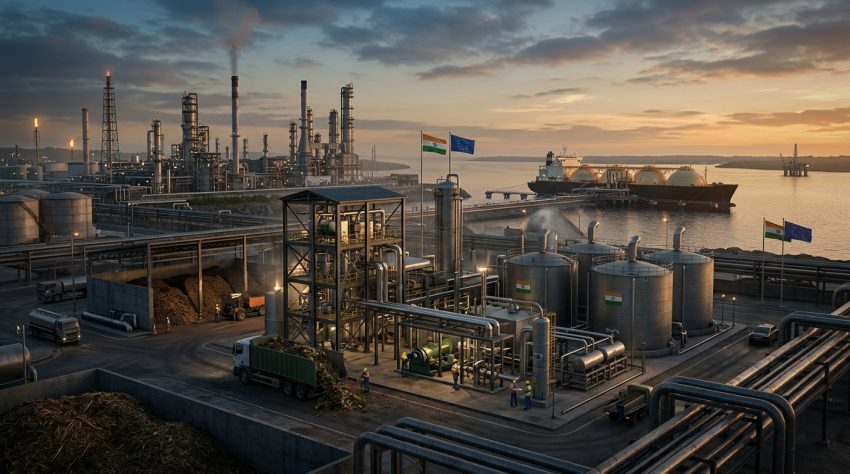
Strategic Alliance Shapes India’s Biogas Infrastructure Expansion
Petronet LNG Limited, India’s primary liquefied natural gas import and regasification operator, has formalized a substantial joint venture with Gruner Renewable to establish a network of compressed biogas (CBG) production facilities across the nation. The partnership, capitalized at ₹1,200 crore, represents a strategic pivot by India’s state-controlled LNG major into the biomethane value chain—a sector gaining institutional momentum as the country pursues its commitment to renewable energy targets and transportation decarbonization.
This collaboration is noteworthy because it positions Petronet, traditionally anchored in LNG import logistics and pipeline infrastructure, as an active investor in domestically sourced biogas projects. The structure signals confidence in India’s emerging CBG ecosystem while leveraging Petronet’s existing gas marketing and distribution capabilities. The 10-plant rollout provides a tangible expansion roadmap for a technology that remains nascent relative to global biogas markets but increasingly central to India’s gas supply diversification strategy.
Understanding Compressed Biogas in India’s Energy Context
Compressed biogas represents a renewable substitute for compressed natural gas (CNG) and diesel, produced through anaerobic digestion of agricultural residue, animal waste, and organic municipal feedstock. Unlike conventional biogas, CBG undergoes upgrading and compression to pipeline-specification purity, enabling integration into existing gas infrastructure without major retrofitting—a critical advantage for rapid deployment in India’s gas distribution networks.
India’s CBG sector has historically remained underdeveloped relative to potential. Agricultural biomass availability exceeds 500 million tonnes annually, yet only a fraction channels into organized biogas production. Government policy—including the Sustainable Alternative Towards Affordable Transportation (SATAT) initiative launched in 2018—aims to incentivize CBG production through fuel purchase agreements and viability gap funding. However, project financing, feedstock aggregation, and technology scale-up have constrained growth. Petronet and Gruner’s intervention addresses these structural bottlenecks.
Gruner Renewable, a focused renewable energy player, brings specialized biogas development expertise, while Petronet contributes capital, pipeline connectivity, and offtake agreements—a complementary skill combination essential for project bankability. This alignment mirrors international best practices where established energy infrastructure majors de-risk emerging fuel pathways through strategic partnerships.
Implications for India’s Transportation Fuel Security
The 10-plant portfolio is projected to contribute meaningfully to India’s medium-term CBG capacity target. Each plant’s specific production capacity remains undisclosed, but industry benchmarks suggest facilities of 10–15 tonnes-per-day throughput are economically viable at current feedstock costs and government support levels. Aggregated production could displace roughly 50,000–70,000 tonnes of petroleum-equivalent annually—modest in absolute terms but symbolically significant for a fuel category where India currently operates fewer than 100 operational units.
CBG deployment addresses multiple policy imperatives: reducing dependence on imported petroleum, monetizing agricultural waste (reducing stubble-burning in northern states), and lowering transport-sector emissions. For fleet operators—trucking companies, logistics providers, urban transit authorities—CBG offers cost arbitrage versus diesel over medium-term horizons, contingent on stable government subsidy frameworks and production scale.
However, scalability challenges persist. Feedstock collection logistics in rural areas require investment in supply-chain infrastructure beyond production equipment. Competition for agricultural residue from bioenergy and thermal-power sectors adds cost pressures. Success of this JV will depend on operational efficiency in feedstock procurement and project execution across geographically dispersed plant sites.
Strategic Positioning Within Petronet’s Diversification Narrative
Petronet LNG’s diversification into CBG reflects broader strategic recalibration within India’s state-owned energy sector. With LNG import volumes subject to global market volatility and domestic demand growth moderating, Petronet has signaled intent to develop adjacent revenue streams in gas infrastructure and renewables. Prior investments include participation in city gas distribution projects and LNG regasification terminals in southern and eastern India.
The CBG venture is consistent with this playbook—leveraging existing core competencies (gas marketing, pipeline operations) to capture value in emerging fuel markets. From Petronet’s perspective, CBG production yields long-term contractual revenue visibility and aligns corporate positioning with India’s renewable energy narrative, relevant for institutional investor relations and government stakeholder management.
Gruner Renewable’s partnership with a state enterprise also signals market confidence in CBG viability at scale. Private renewable developers have historically viewed India’s CBG economics as marginal without durable government support. Petronet’s participation, backed by sovereign creditworthiness and policy access, de-risks the venture for smaller investors and suppliers.
Broader Competitive and Regulatory Landscape
This JV enters a competitive context where other major energy firms—including Indian Oil Corporation (IOCL) and private renewable majors—are exploring CBG investments. IOCL has separately launched CBG procurement and blending initiatives. Regulatory clarity via the SATAT scheme and potential extensions of income-tax incentives for biogas producers provide supportive policy tailwinds, though subsidy sustainability remains subject to fiscal priorities.
International precedent (Europe’s biomethane mandates, Brazil’s sugar-cane bagasse biogas programs) suggests that 10-plant deployments represent feasible incremental steps toward sector maturation, typically requiring 5–7 years to reach stable operational performance. Petronet and Gruner’s timeline for plant commissioning and production ramp-up will be closely monitored by investors and policymakers as a bellwether for domestic CBG scalability.
The ₹1,200 crore capitalization is proportionate to a 10-unit pipeline—suggesting plant-level CAPEX of ₹120 crore on average, consistent with documented biogas project costs in India’s SATAT ecosystem. Assuming debt funding of 60–70% of project cost, the JV’s equity contribution signals investor conviction in unit economics and government policy continuity.
Conclusion
The Petronet LNG–Gruner Renewable CBG joint venture exemplifies India’s incremental but deliberate progress toward renewable gas infrastructure maturity. By coupling Petronet’s institutional strength and gas-sector experience with Gruner’s biogas specialization, the partnership positions itself to overcome historical bottlenecks in project finance and feedstock aggregation. The 10-plant rollout offers measurable progress on India’s CBG capacity roadmap while reinforcing state-led energy transition pathways aligned with transportation decarbonization and agricultural waste valorization.
For FuelWings readers—energy sector investors, fuel procurement professionals, and policy analysts—this venture merits attention as a barometer of CBG sector viability and a case study in how India’s legacy energy majors are repositioning within renewable fuel frameworks. Success will depend on operational execution, sustained government support, and competitive CBG economics relative to conventional and alternative fuel options. The coming 18–24 months will prove instructive as initial plants reach commissioning milestones.
By FuelWings Energy Desk · Reviewed by FuelWings Editorial Team · Published 23 October 2026 IST. FuelWings covers India & global oil, gas and fuel-price news; figures are verified against the original report and public data.
Topics: Petronet LNG, Gruner Renewable, compressed biogas, CBG plants, renewable energy India, biofuel infrastructure, green fuel transition, energy sector JV.
Source: ET EnergyWorld (Oil & Gas) ↗